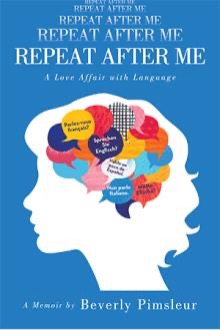
Repeat After Me: A Life Shaped by Language
In the beginning …
Have you ever wondered where The Pimsleur Method came from? Who Dr. Paul Pimsleur was? We know he doggedly pursued his dream of understanding how people learn and remember, and as a French professor, he naturally turned his attention to his students. He took a hard look at the way foreign languages were typically taught at that time – by rote, by reading, by memorizing verb conjugation tables. He noticed that it was a far cry from the skills his students needed to know when first setting foot in a new country. His curiosity and determination led to a wholly new approach to language learning, and his wife, Beverly was with him every step of the way. She describes it all in her new memoir, Repeat After Me, published by Archway Publishers.
Beverly had some ideas of her own about learning a language. She describes the experience of moving from Kentucky to Ohio as a child and realizing that her strong southern accent made her stand out. She discovered that the way you spoke could change you from an outsider to an insider. Determined to fit in, she struggled and worked at it and eventually succeeded in losing her southern drawl, but it was a transformative experience.
Repeat After Me is a personal account of what it feels like to live a life shaped by language — learning it, struggling with it, relying on it, and returning to it again and again.
The Partnership of A Lifetime
She recounts her first (blind) date with Paul, and their early years together. His theories were revolutionary at the time. He was refining his interactive method at Ohio State University in a Listening Lab sponsored by Ohio Bell. When portable tape players were introduced, he envisioned getting his students out of the lab and let them learn by listening and speaking – a method he felt more closely approximated how they’d be using the language in real life.
In 1962 after winning a grant from the US Department of Health, Education & Welfare, Paul and Beverly set off for Greece to work on developing a fifteen-lesson pilot course. They wanted to test Paul’s theories in a language that used a non-Roman alphabet. They had four months and a stipend of $25,000. Once in Greece, they sublet an inexpensive apartment in the old town and began advertising for students. Paul found what he called, “a native informant” and the method was born.
As Paul’s reputation as an applied linguist grew, so did their family. He was asked to apply for a Fulbright Scholarship to teach at the University of Heidelberg, but living in Germany would mean learning German. Beverly took to the language immediately, and their first child was born there.
In 1967, much of Paul’s work on oral proficiency metrics, graduated interval recall, and listening-first instruction were incorporated into the Modern Language Association which evolved into ACTFL, The American Council on the Teaching of Foreign Languages. His contributions to self-instructional learning was becoming legendary.
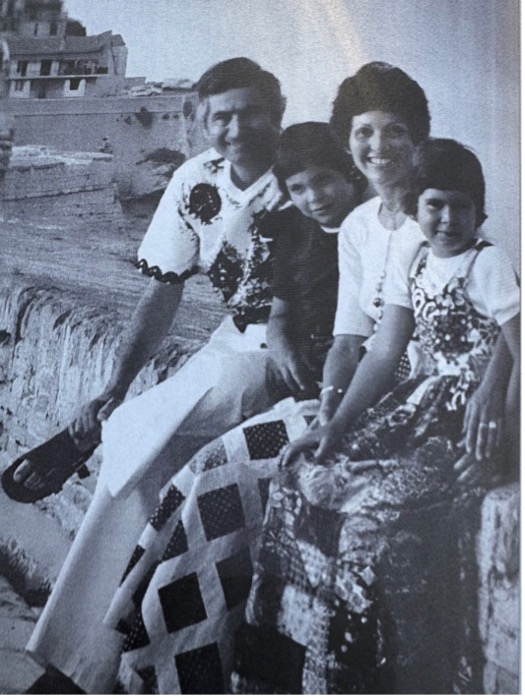
In 1971, he was invited to write a Twi course for the Peace Corps, and the family spent several months in Ghana for a brief period before returning to the U.S. Only a few short years later – Paul was 48- he died suddenly of a heart attack while teaching at the Sorbonne in Paris. It was a tragic ending to a promising life, but he would have been grateful to know that his legacy would touch millions of lives.
Fluency Isn’t the Finish Line
As adults, many of us come to language learning carrying old assumptions: that we’re “bad at languages;” that mistakes are something to avoid. In Repeat After Me, Beverly Pimsleur quietly pushes back on those ideas, not by arguing with them, but by showing how universal those feelings are. Fluency, as the book makes clear, isn’t a finish line. It’s a relationship.
An emphasis on listening and speaking aloud feels familiar to anyone who’s learned a language with a Pimsleur course. You don’t start by knowing everything. You start by tuning in. You repeat. You listen again. Gradually, things begin to stick — not because you’ve memorized them, but because you visualized yourself in a realistic situation using them. By exploring her years with Paul through the lens of a lifetime, Beverly shows us the human side of Paul’s legacy. Embracing new experiences, new cultures with a sense of adventure and curiosity is how confidence builds, how fear recedes, how you can begin to speak with a new voice that begins to feel like your own.
Repeat After Me is also a memoir of partnership, travel, work, and loss. Her tone is reflective without being nostalgic, and she shows us Pimsleur the man without artifice or glamor.
To Understand and Be Understood
People come to language learning for all kinds of reasons — travel, work, love, curiosity. What Repeat After Me reminds us of is that underneath those reasons is something simpler: the desire to be understood, and to understand others. This memoir will remind you — quietly, and a little insistently — that language changes who we are, often before we realize it, and long after we think we’re done learning.
Repeat After Me by Beverly Pimsleur is available on Amazon, from Archway Publishing, and Barnes and Noble.